A talk for first-year Data Science & AI students
Data & AI —start?
What this field does, what to learn, and what the job really looks like — answered from your own questions.
Intro 02 / 52
About the speaker
Trần Quang Huyên
AI Engineer at Everfit
Master's
Electronics Engineering
Specialized in AI · Da Nang University of Science and Technology
Research
AI in medical imaging
Quantum Machine Learning
Recent publications · 2025
Efficient Circuit Classifier Design for Enhancing Quantum Self-Attention in Vision Transformers IEEE Globecom Workshops Comparative Analysis of Deep Learning Architectures for Brain Tumor Segmentation Int. Conf. on Advanced Technologies for Communications (ATC)
Intro 03 / 52
Today we'll cover 01
Case study
From your survey to an end-to-end data project
02
The industry
Career roles, market, trends
03
The real job
A working day, how projects run
04
What to learn
What, in which order, and where
05
Profile & career
What employers want, growth, mistakes
06
Q&A
All 18 of your questions
01 — Case study 04 / 52
01
Case study:
This talk is itself a small data project. Here is how it was built, end to end.
01 — Case study 05 / 52
An end-to-end data project
1
Ask
What should this talk cover?
?
2
Collect
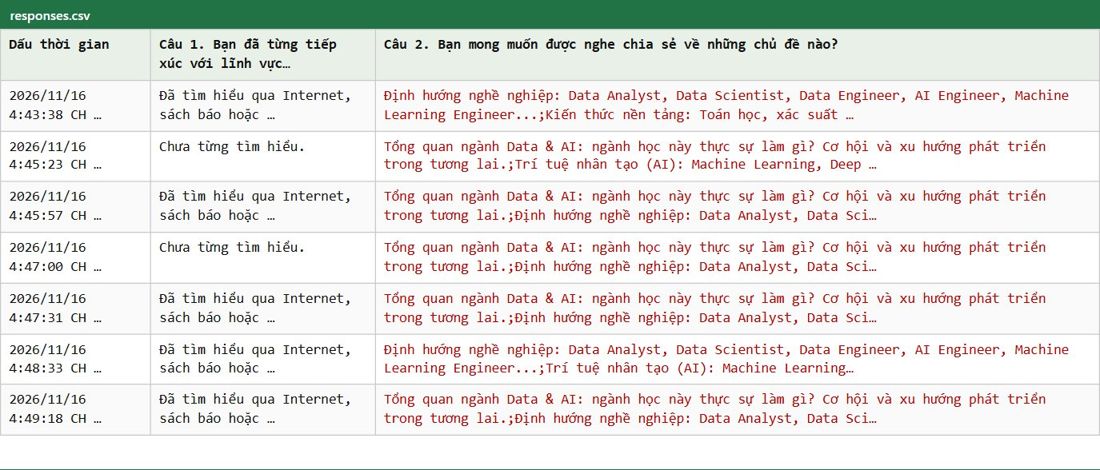
Google Form · 9 questions · 29 responses
3
Clean
Export CSV · split answers · merge duplicates
4
Analyze
Count · ratio · rank
5
Visualize
Charts · tables
6
Act
Design today's content
Google Forms → CSV → Python → Notion → HTML slides
01 — Case study 06 / 52
1
Ask the question
Start from the problem — not from the data.
Problem: one talk, limited time, many possible topics Question: what do you actually need to hear most? Success: your real questions get answered Lesson A clear question decides what data you need to collect.
01 — Case study 07 / 52
2
Collect the data
Designing a form is designing your data.
Anonymous, name optional → more honest answers Multiple choice to count · open text to capture real questions 9 questions, 3–5 minutes → most people finish Reality: the first version had 2 duplicate questions and 1 question that lost all its options — we fixed the form while it was live.
Lesson Always test with a few people before sending it to everyone.
01 — Case study 08 / 52
3
Clean the data
Real data is rarely usable as-is.
Google Forms joins multiple answers with commas — but the answers themselves contain commas (“Python, SQL, Power BI…”) → Splitting on commas fails; match against the original option list instead 40+ open-text ideas → merged into 18 questions in 4 groups for option in OPTIONS:
if option in answer:
counts[option] += 1
Lesson Most of a data project's time is spent right here.
01 — Case study 09 / 52
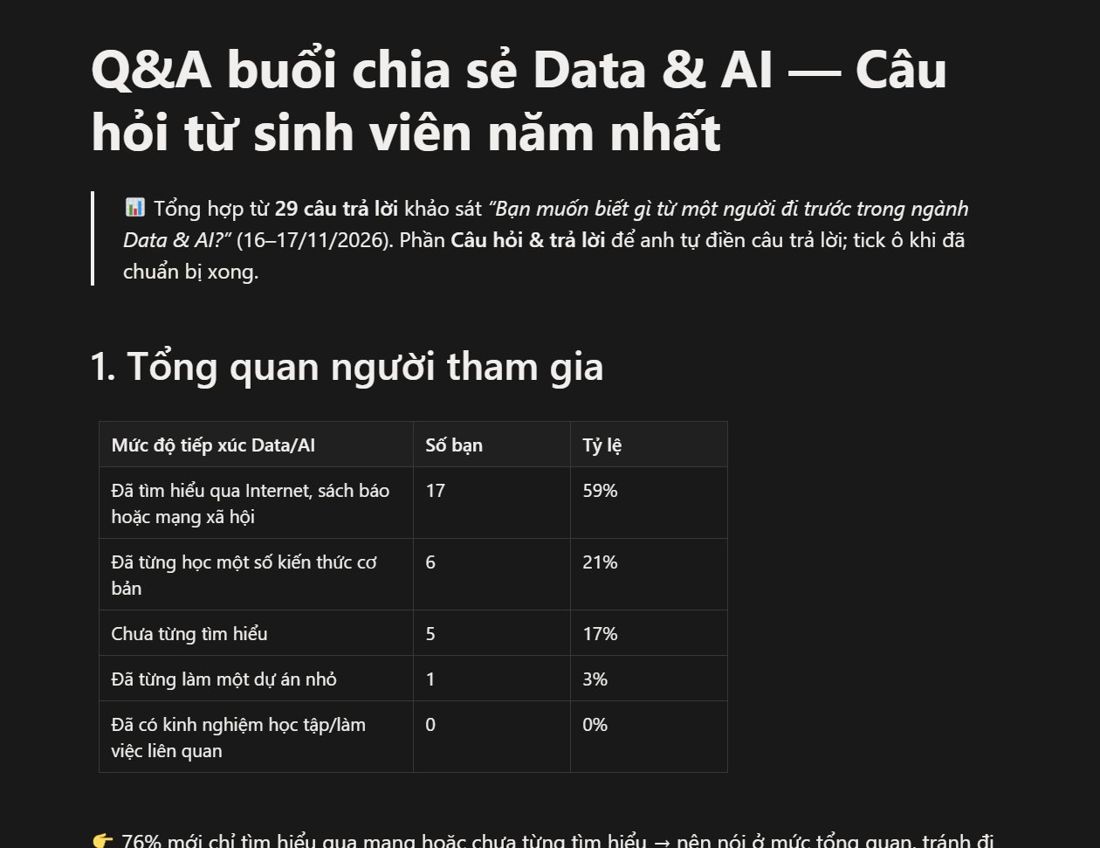
Step 4 · Analyze — Who are you?
76%
have only read about Data & AI online — or never looked into it
17
read about it online, in books, on social media
→ Today stays high-level, light on algorithms.
01 — Case study 10 / 52
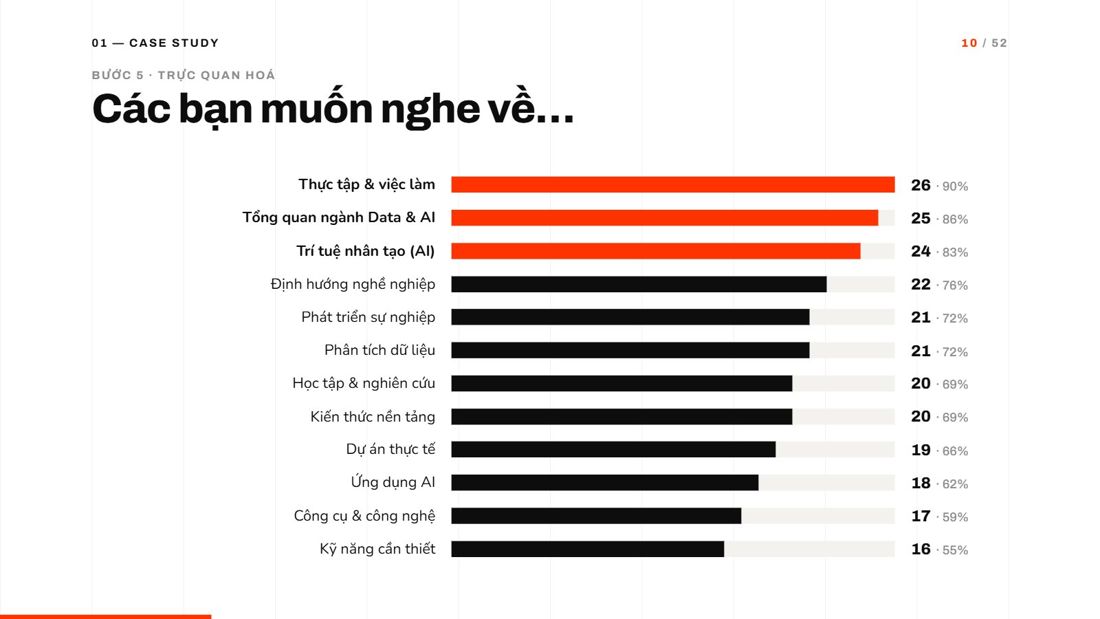
Step 5 · Visualize
You want to hear about…
Internships & jobs
26· 90%
Overview of Data & AI
25· 86%
Artificial intelligence
24· 83%
Studying & research
20· 69%
Tools & technology
17· 59%
01 — Case study 11 / 52
Step 5 · Visualize
What worries you most
Can't picture the real job
18· 62%
Worried about job prospects
18· 62%
Don't know how to build projects
17· 59%
Don't know where to start coding
15· 52%
Don't fully understand the major
12· 41%
Don't know how to self-study
11· 38%
Don't know which tools / languages
10· 34%
Math & statistics feel hard
9· 31%
Don't know how to learn with AI
5· 17%
01 — Case study 12 / 52
Step 5 · Visualize
After today, you want to…
Have a 4-year study roadmap
7· 24%
Understand the field better
6· 21%
Know what to learn first
6· 21%
Get clearer career direction
3· 10%
Understand the workplace
3· 10%
Connect with people in the field
2· 7%
01 — Case study 13 / 52
Step 6 · Act
From insight to today's content 90% want to know about internships & jobs
→
05 — Profile & career
62% can't picture the real job
→
03 — The real job
Top wish: a 4-year study roadmap
→
04 — What to learn
76% are just getting started
→
Stay high-level, few algorithms
01 — Case study 14 / 52
3 lessons from a very small project 1
Question first, data second
Know which decision you need to make, then design how to collect.
2
Real data is always “dirty”
Broken forms, commas inside answers, abbreviations — all normal.
3
Analysis must lead to action
A nice chart isn't enough; the result has to change a decision.
02 — The industry 15 / 52
02
The industry
Career roles, the market, and AI in practice.
Q 1 Q 2 Q 3 Q 8
02 — The industry 16 / 52
Before we talk about jobs
How do AI, ML, DL and Data Science relate?
Artificial Intelligence Machine Learning Deep Learning Data Science
Artificial Intelligence
Machines doing tasks that normally need human intelligence.
Machine Learning
A branch of AI: machines learn patterns from data instead of hand-written rules.
Deep Learning
A branch of ML: many-layered neural networks — images, speech, language (LLMs).
Data Science
Getting insight from data with statistics and analysis — using ML/DL when needed.
The overlap: Data Science uses ML as a tool — but not all Data Science work is AI.
02 — The industry 17 / 52
What can you do with a Data Science & AI degree?
5 core roles — one flow of data
01
Data Engineer
Is the data ready?
SQL · Spark · Airflow
02
Data Analyst
What happened, and why?
SQL · Excel · Power BI
03
Data Scientist
What will happen next?
Python · Statistics · ML
04
ML Engineer
How does the model run for real?
PyTorch · APIs · MLOps
05
AI Engineer
How do we build AI products?
LLM · RAG · Agents
Also: BI Analyst · MLOps Engineer · Research Scientist · Data Product Manager…
02 — The industry 18 / 52
App Web Stores ETL / Streaming Warehouse BI · ML Role 1 / 5
Data Engineer Builds the “pipes” so data arrives correct, complete, and on time.
Learning path
Solid SQL & Python Databases, data-warehouse modeling ETL/ELT & orchestration: Airflow, dbt Big data & cloud: Spark, Kafka, AWS/GCP Day-to-day work
Collect data from many sources: apps, web, sales systems Clean, standardize, load into the warehouse Monitor pipelines: fix late, missing, or wrong data Use case 1 Retail data warehouse
Sales data is scattered across stores, web, and app → unify it in one warehouse, refreshed nightly → the whole company shares one revenue number.
Use case 2 Real-time data
A ride-hailing app needs driver locations every second → a streaming pipeline (Kafka) feeds the matching system.
02 — The industry 19 / 52
Data Analysis Channel B ↓ 15% Decision Role 2 / 5
Data Analyst Turns data into answers to business questions.
Learning path
SQL · Excel / Google Sheets Descriptive statistics & hypothesis testing BI: Power BI, Tableau Data storytelling, business understanding Day-to-day work
Take questions from sales and marketing Query, analyze, find root causes Build dashboards, reports, recommend actions Use case 1 Monthly revenue down 15%
Break it down by region, channel, product → the drop is concentrated in one channel after a delivery-policy change.
Use case 2 Checkout A/B test
Compare 2 versions with a statistical test → ship the one that lifts orders. Today's survey case study is Data Analyst work too.
02 — The industry 20 / 52
History Model 82% churn risk Role 3 / 5
Data Scientist Builds models that predict and support decisions.
Learning path
Math: probability & statistics, linear algebra Python: pandas, scikit-learn Machine Learning & model evaluation Experiment design, domain knowledge Day-to-day work
Turn business problems into prediction problems Prepare data, engineer features, train & evaluate models Explain results to non-experts Use case 1 Customer churn prediction
A telco / app predicts who is about to quit → customer care sends offers to the right people before they leave.
Use case 2 Credit scoring
A bank predicts repayment ability from transaction history → faster loan approval, fewer bad debts.
02 — The industry 21 / 52
Notebook API · Docker Product Monitor → retrain Role 4 / 5
ML Engineer Takes models from a notebook into a product that runs for real.
Learning path
Strong programming: Python, data structures, Git ML & Deep Learning: PyTorch Backend & APIs: FastAPI, Docker MLOps: deploy, monitor, retrain Day-to-day work
Package models as fast, stable APIs Automate training & deployment pipelines Monitor: data shifts → accuracy drops → retrain Use case 1 Product recommendations
An e-commerce site shows “you may also like” to millions of users, answering in tens of milliseconds.
Use case 2 Fraud detection
Every card transaction is risk-scored by a model right before approval.
02 — The industry 22 / 52
Question LLM Docs (RAG) Tools / APIs Answer + sources Role 5 / 5
AI Engineer Builds applications on top of AI models — especially LLMs.
Learning path
Solid programming & backend Deep Learning, NLP, Transformers LLMs: prompting, RAG, fine-tuning Agentic systems, evaluation & safety Day-to-day work
Connect LLMs to company data and tools Design RAG and agents; measure answer quality Optimize cost and latency; control hallucinations Use case 1 Internal docs chatbot
Staff ask about processes and policies → a RAG system finds the right document and answers with sources.
Use case 2 Customer-service agent
Looks up orders, reschedules, files tickets by calling system APIs — not just replying with text.
02 — The industry 23 / 52
Q 1
What's the Data & AI market like in Vietnam? What if the “AI bubble” bursts?
You asked
“If the “AI bubble” bursts, what changes, and what will be expected of us?”
18/29 are worried about job prospects
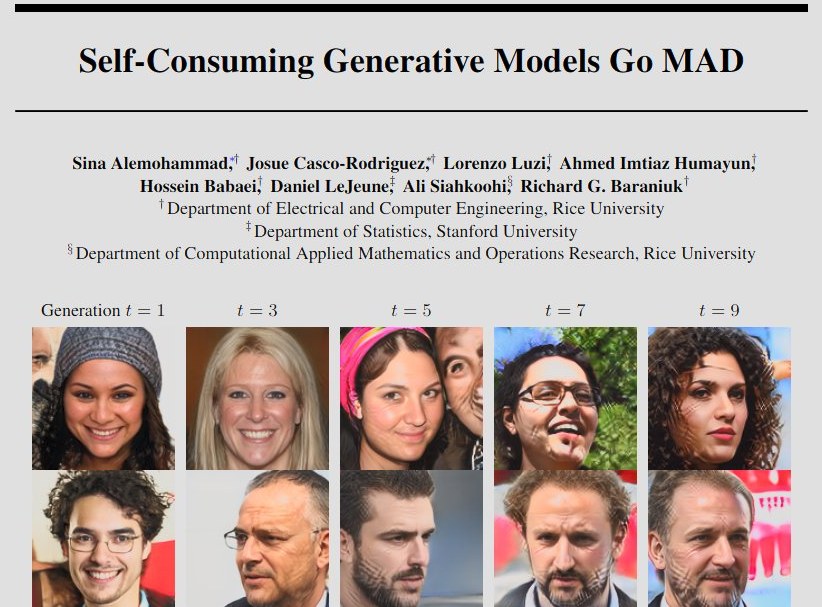
AI trained on AI-generated data → quality and diversity drop with every generation (Model Autophagy Disorder). Alemohammad et al., “Self-Consuming Generative Models Go MAD”, Rice & Stanford, 2023 · arXiv:2307.01850 Answer
01 Ultimately, AI is the crystallization of past labor — it can't replace the value of present labor. 02 We still need people to create new data and to keep AI in check.
02 — The industry 24 / 52
Q 2
Will Data Science still be “hot” in Vietnam and Da Nang in 5–10 years?
You asked
“In 5 or 10 years, will Data Science jobs still be hot in Vietnam in general and in Da Nang in particular?”
Today Next 5–10 years Tech never goes out of date Answer
01 Nobody can say for sure. 02 But the general trend: technology and high-tech jobs never go out of date.
02 — The industry 25 / 52
Q 3
What do the roles pay? If AI replaces some roles, what should we do?
You asked
“Average salary for each role, from junior to senior.”
“As AI becomes common and replaces some roles in the field, what should we do starting now?”
0 10 20 30 40 Junior 4–15 Mid 15–25 Senior 25–35 million VND / month · varies by company Answer
01 It depends on the company. As far as I know, roughly: 02 Junior 4–15 · Mid 15–25 · Senior 25–35 (million VND / month)
02 — The industry 26 / 52
Q 8
How is AI used in practice? How do I pick the AI direction that fits me?
You asked
“AI is very broad, so I want to see how it's applied in practice to find which application suits me best.”
24/29 chose the AI topic
→
Answered live during the session
03 — The real job 27 / 52
03
The real job
What working in the field actually looks like.
Q 4 Q 5 Q 6 Q 7
03 — The real job 28 / 52
Q 4
What does a working day in this field look like?
You asked
“I want to understand what my job will actually look like.”
18/29 can't picture the real job yet
≠ Build from scratch Operate · maintain Answer
01 Building a project from scratch is different from operating and maintaining an existing one.
03 — The real job 29 / 52
Q 5
How many hours a day? Can I leave early if I finish early?
You asked
“How many hours does an employee work on average? If I finish early, can I go home early?”
Answer
01 8 hours a day, like any normal job. 02 Whether you can leave early depends on the company — but finishing early does usually mean some free time.
03 — The real job 30 / 52
Q 6
How is school knowledge different from work at a company?
You asked
“What should students prepare so they aren't caught off guard?”
“I don't really understand what companies need from me yet.”
What school teaches What companies use Answer
01 Companies use far less knowledge than you learn at school. 02 So learn what's taught at school solidly.
03 — The real job 31 / 52
Q 7
How does a Data/AI project run from start to finish?
You asked
“Real project experience: the process of building a Data/AI project end to end.”
17/29 don't know how to build a personal project
Analyze client requirements Mine the data … Answer
01 Analyze the client's requirements 02 Mine the data 03 … next steps: see the case study in part 01
04 — What to learn 32 / 52
04
What to learn
What, in which order, and where.
Q 9 Q 10 Q 11 Q 12 Q 13 Q 14 Q 15
04 — What to learn 33 / 52
Q 9
What should I learn? Where do I start?
“What does an AI Engineer actually do, and how should I start building the skill set employers want?”
01
Math
Linear algebra · Probability & statistics · Calculus
02
Machine Learning
The core algorithms
03
Deep Learning
Neural Networks · CNN · RNN · LSTM · NLP…
What do employers hire for?
Data analysis
Model building
Backend / APIs to serve models
Very diverse — but it revolves around these three.
04 — What to learn 34 / 52
Q 10
Do I need to know many programming languages?
You asked
“Does this field require knowing many languages?”
10/29 don't know which tools / languages to learn
Python PHP JS C# Dart Kotlin Swift Answer
01 No — Python is enough. 02 Once you master one language, picking up others is easy. 03 I learned Python, then got “pushed” into PHP, JS, C#, Dart, Kotlin, Swift… and handled them all.
04 — What to learn 35 / 52
Q 11 I only started coding recently — is it too late?
Of course not. Everyone has to start somewhere.
What matters most is learning and practicing.
04 — What to learn 36 / 52
Q 12
How do I learn effectively? What should I avoid?
You asked
“Share how you started, how to learn effectively, and what to avoid.”
11/29 don't know how to self-study or find materials
Answer
01 Build up from the basics. 02 Don't skip the parts that don't make sense to you. 03 Whenever you feel you don't fully get it, ask questions.
04 — What to learn 37 / 52
Q 13
Where to learn? Where to practice?
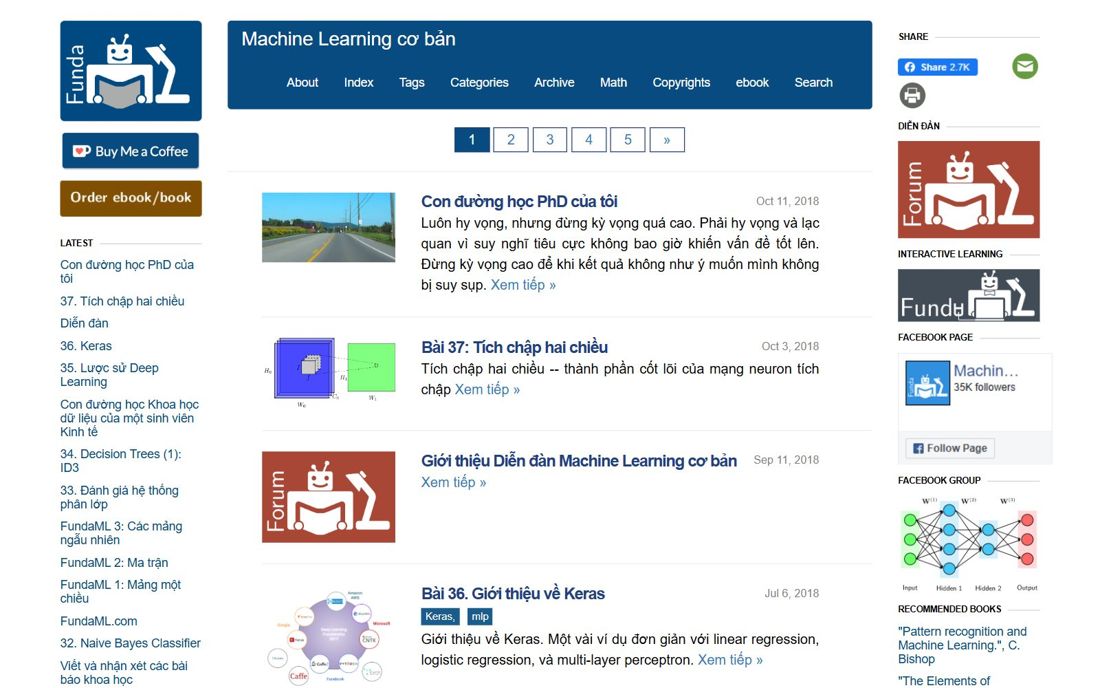
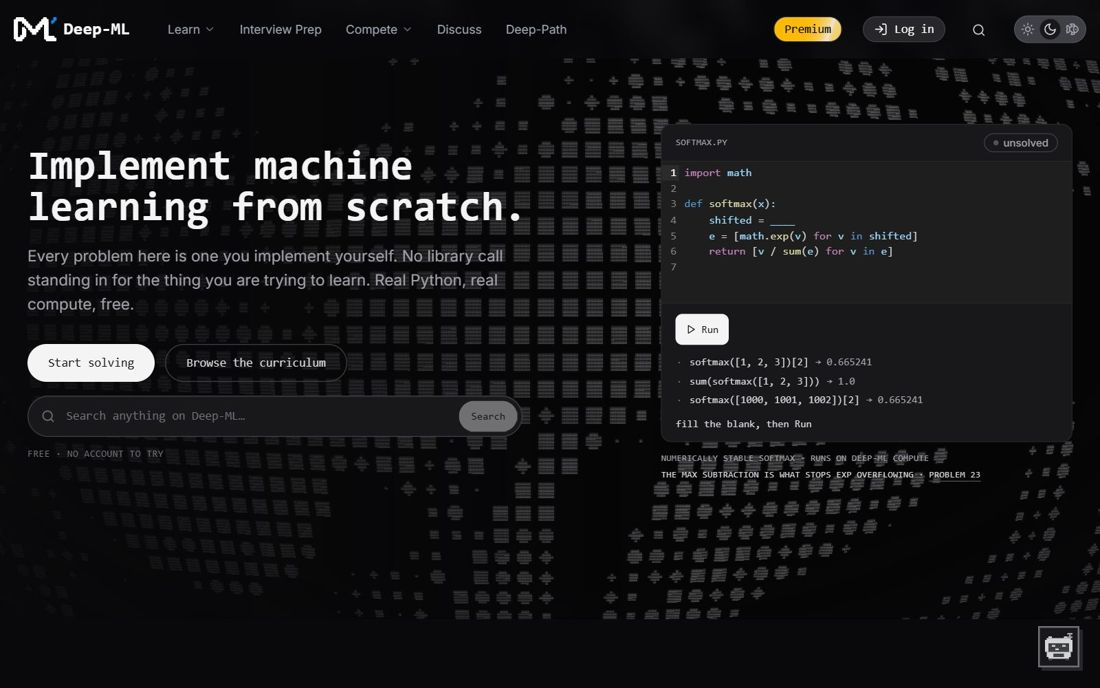
The best material is still papers and books. To get started:
04 — What to learn 38 / 52
Q 14 Does school skip what companies need?
Actually, it's the other way around.
Companies are the ones struggling to apply academic knowledge.
04 — What to learn 39 / 52
Q 14
Is what I learn at university enough for work?
You asked
“Which practical knowledge, skills, or mindsets do companies need that students usually lack?”
University knowledge Business problems solves Answer
01 Real business problems can only be solved with university-level or advanced academic knowledge — not internal experience alone. 02 Many engineers look down on university knowledge and get stuck. It's most obvious in data & AI. 03 For now: master the theory in class. You'll understand once you hit real problems.
04 — What to learn 40 / 52
Q 15
Is building an LLM from scratch feasible?
“Is it feasible to build a large language model from scratch, without relying on any existing model?”
Yes — but be clear: building to learn is far easier; building to commercialize takes enormous resources.
04 — What to learn 41 / 52
Q 15
AI changes constantly — how do I keep up?
You asked
“AI never stops changing, so how can we keep up with the trends?”
LinkedIn Substack Reddit Solid foundations Understand & question Answer
01 Follow channels and blogs: LinkedIn, Substack, Reddit. 02 But to understand what you read, you need solid foundations first. 03 Many buzzwords are hype with little real value — foundations let you question them, and yourself.
04 — What to learn 42 / 52
AI in games and entertainment “How is AI applied in entertainment, like the game industry?”
Bots
Interact with game worlds to automate play
2D / 3D generation
Create characters and graphic assets
Code generation
AI that helps program games
Music & film
AI can make music and film — “but I still prefer things made by people”
05 — Profile & career 43 / 52
05
Profile &
What employers want, how to grow, mistakes to avoid.
Q 16 Q 17 Q 18
05 — Profile & career 44 / 52
Q 16
26/29 care about internships & jobs
Which projects, certificates, or awards impress employers?
“If everyone has personal projects and an internship, what else will stand out to employers?”
There's no fixed answer — it depends on the company and project. Hiring trends keep shifting:
~5 years ago
Computer Vision
05 — Profile & career 45 / 52
Q 16 So how should I do personal projects?
The more fundamental something is, the longer it lasts.
Focus on understanding what you build and what you learn — more than the result. Technology changes fast; fundamentals stay.
05 — Profile & career 46 / 52
Q 17
How do I grow fast?
At work you'll make mistakes and see your weaknesses → that's when you learn. With the new knowledge, go back and practice to sharpen it. Repeat.
“Will AI Engineers be replaced by AI too?” If AI Engineers get replaced by AI, who builds the AI? 🤔
05 — Profile & career 47 / 52
Q 18
Most-mentioned wish in the survey
Common mistakes when you're new “What mistakes do fresh graduates commonly make in this field?”
Security
My most frequent mistake. If you don't see a vulnerability, it's very hard to fix once it's exploited.
Time estimates
Add 20% to your original estimate. Estimate too tight and you burn out — in outsourcing you may even owe contract penalties.
Logging
Log the main data flows when you code — but don't log too much.
Using AI
Using AI is great, but you still have to learn. AI output always needs human review.
06 — Q&A 48 / 52
06
Q&A
All your questions — with page numbers to review later.
06 — Q&A 49 / 52
Your 18 questions (1/2)
06 — Q&A 50 / 52
Your 18 questions (2/2)
06 — Q&A 51 / 52
Your turn
Any question not on this list?
Just ask — there are no silly questions.
Wrap-up 52 / 52
Take home
1
Foundations first, trends later
Math, ML, DL — the more fundamental, the longer it lasts.
2
Python is enough to start
Master one language and the rest come fast.
3
Learn → practice → repeat
The only way to go fast and go far.
4
AI is a tool, not a substitute for learning
AI output always needs human review.
Thank you! Trần Quang Huyên
Scan to connect on LinkedIn 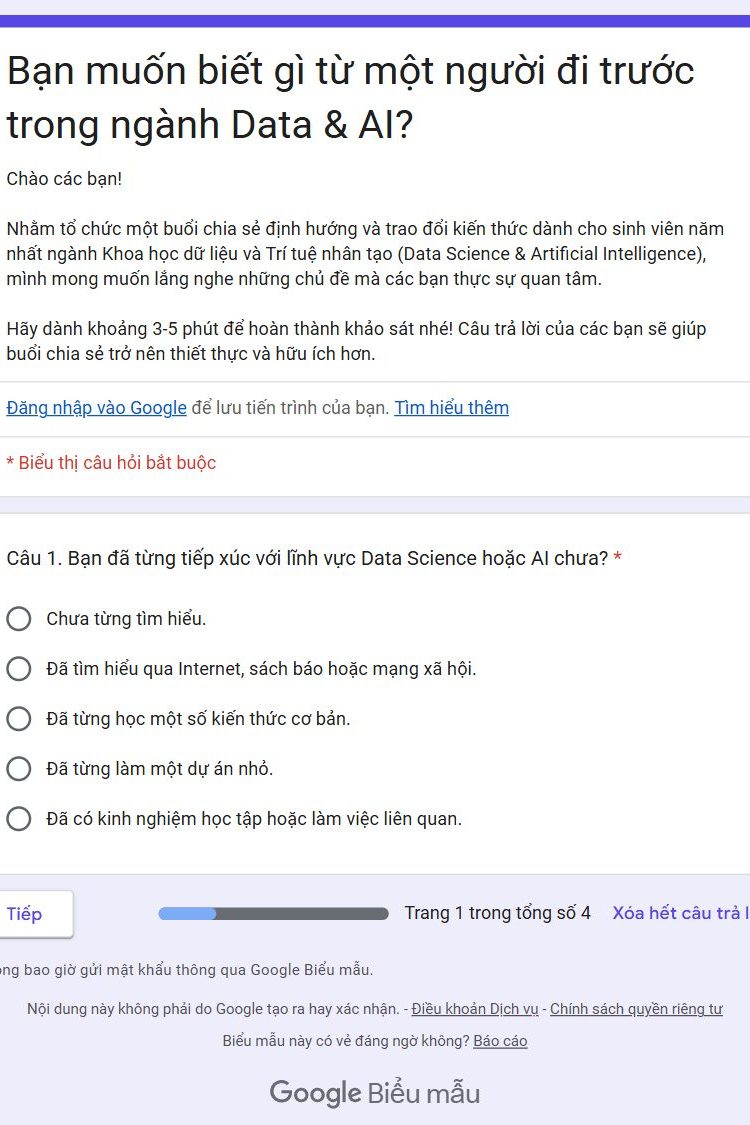
 Scan to connect on LinkedIn